Some Units Lose Signal, Others Don't
Usually a sign of dish misalignment, often from wind or settling over time.

If you're looking for this page, you've probably already found out how hard SMATV service is to come by. Most cable and satellite providers stopped supporting these systems years ago, once streaming became the default. American Broadband Networks is one of the few teams in the Charlotte, NC area still equipped to service, repair, and maintain SMATV systems — whether we installed the original system or not.
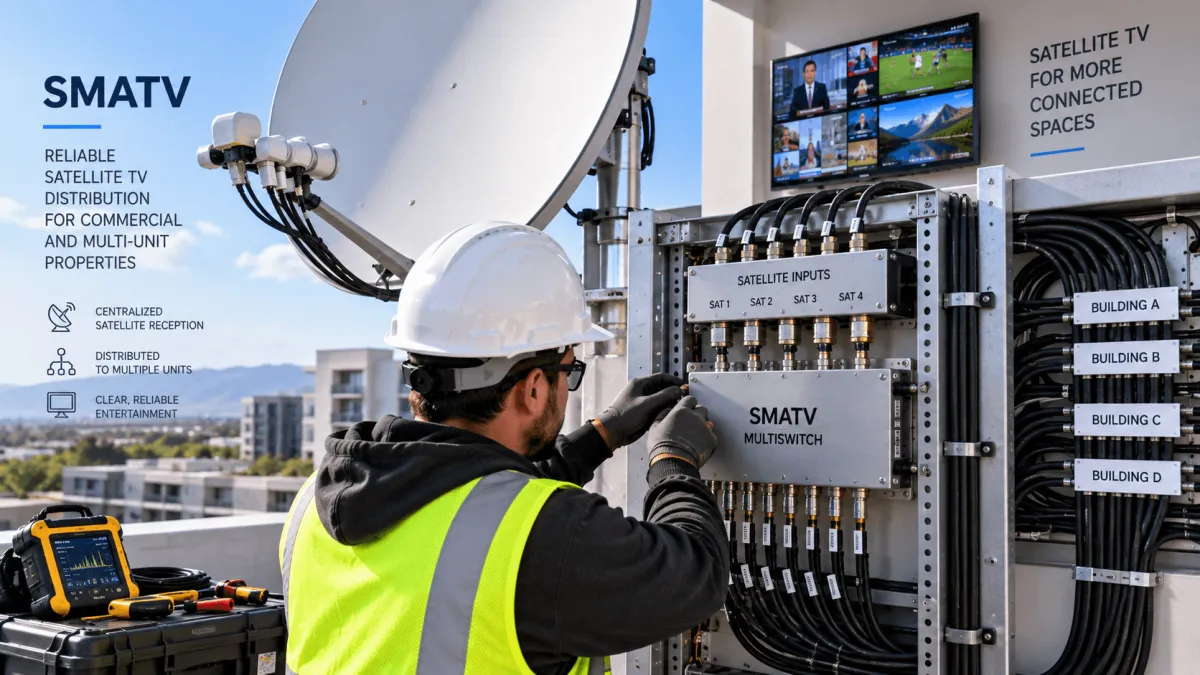
SMATV — Satellite Master Antenna Television — is a shared satellite TV system built around a single dish, or a small cluster of them, feeding a central head-end. From there, the signal is distributed through the property's existing coaxial wiring out to every unit, the same way a cable system would, except the programming source is satellite reception instead of a cable provider's feed.
One shared satellite source receives the programming.
The incoming satellite signal is processed centrally.
Existing coaxial infrastructure carries the signal throughout the property.
Residents or guests receive service from the shared system.
It's the setup behind a lot of older apartment communities, condo associations, and hotels: one shared satellite source doing the job that would otherwise require a dish on every balcony or roofline.
Many HOAs and condo associations restrict or prohibit individual satellite dishes, making a shared system the only practical option.
The coaxial wiring is already run to every unit — replacing that wiring to switch systems is disruptive and expensive for a property that doesn't need to.
A working SMATV system that residents rely on isn't something a property wants to rip out without a real reason to.
Servicing SMATV requires two skill sets most current technicians only have one of.
Understanding and troubleshooting the satellite reception side of the system.
Understanding the internal infrastructure distributing the signal across the property.
As satellite and cable companies shifted their technicians toward streaming-based services, that combined skill set became rare.
It's not that the systems disappeared — it's that fewer people are still trained to work on them.
Usually a sign of dish misalignment, often from wind or settling over time.
Often points to a failed amplifier or splitter somewhere in the distribution plant, not the dish itself.
Typically traces back to the head-end or the main dish feed rather than individual unit wiring.
Decades-old coax and connectors degrade even when nothing else has changed.
We diagnose and repair existing SMATV systems — dish alignment, head-end equipment, and the distribution plant that carries signal to every unit — regardless of who installed the system originally.
Trace the issue and determine which part of the SMATV system is causing the problem.
Correct the fault in the dish, head-end, or internal distribution infrastructure.
Keep the system operating reliably instead of waiting for the next failure.
Checking and correcting dish position and incoming satellite signal.
Diagnosing the central equipment responsible for receiving and processing the signal.
Troubleshooting the coax, amplifiers, splitters, connectors, and taps serving each unit.
We also handle ongoing maintenance for properties that want to keep their system running reliably rather than waiting for it to fail.
No. We service and repair existing SMATV systems regardless of who originally installed them.
Not for every property. Many HOAs and older buildings still rely on SMATV because of restrictions on individual dishes or because the shared system already works — streaming doesn't replace that infrastructure by itself.
That pattern usually points to a distribution issue — a failed amplifier or splitter — rather than a problem with the satellite dish itself, though a full diagnosis confirms it.
Both. We handle repair calls and ongoing maintenance for properties that want to avoid a system-wide outage.
Call (336) 210-5445 to describe the issue, and we'll get a technician scheduled as quickly as possible given current availability.
One of the few teams still equipped to keep an SMATV system running.
Phone: (336) 210-5445
Email: [email protected]
Business Hours:
Mon - Fri : 8:00AM - 5:00PM
Sat - Sun : Closed
© 2026 All Rights Reserved | American Broadband Networks
Website Done By: LocalEyes